How to Read a Tablet Weaving Pattern

This document was originally written as an instructional pamphlet. It was first distributed at a class I taught during a session of E Kingdom University on ii May 1992 in the Shire of Quintavia, E Kingdom. (That's a sectionalization of the Society for Artistic Anachronism, Inc., for those of you who are lost.) Appropriately, the focus of this document is on pre-modern historical European occurrences of the weave and on re-creating the weaves in the context of the SCA. It has been somewhat re-written for web posting, and some additional information has been added on the artifact of this weave.
This document is provided as is without whatsoever express or unsaid warranties. While every effort has been taken to ensure the accurateness of the information independent, the author assumes no responsibility for errors or omissions, or for damages resulting from the use of the information contained herein.
Permission is granted to make and distribute verbatim copies of this document for non-commercial private enquiry purposes provided the copyright find and this permission find are preserved on all copies.
Intermediate Tablet Weaving: Figured Double-Confront Weave
Text and figures © 1992, 1999 Carolyn Priest-Dorman
Introduction
This pamphlet introduces ane menstruum technique for achieving a figured tablet weave. It assumes some basic knowledge of the mechanics and terminology of tablet-weaving. All instructions included herein assume that you lot take completed at least one tablet-weaving projection and that you want to know more than about historical techniques of tablet-weaving. Yous should already know how to read a tablet-weaving draft, number your tablets, correctly thread the tablets and warp whatever kind of loom you apply based on the draft, follow a turning sequence, and remove the piece from the loom. It is also assumed that yous thread your tablets with the printed side toward the right, with Tablet 1 at the left side of the pack, and that yous weave away from yourself.
Some Important Preliminary Terms
The term "domicile position," fatigued from the book Step by Footstep Tablet Weaving, refers to the basic starting indicate of a sequence of weaving. Specifically, it refers to the position of the tablets wherein holes C and D are closest to the fell (woven function of the piece, every bit opposed to the equally-all the same-unwoven part, or warp). In this position holes A and B are closest to the warp. Thus, holes A and D are "upwardly." However, it is important to exist aware that not all commercial instruction or draft books rely on this detail interpretation of "domicile position." Russell Groff's blueprint drafts, for example, require beginning with holes A and D closest to the vicious. Nevertheless, all the threading diagrams and turning sequences in this pamphlet are predicated on the initial placement of the tablets in "home position."
The term "warp-twined selvedges" refers to selvedges that are executed in plain weave (i.e., continuous forward turning) irrespective of the technique used for the rest of the weaving. They provide firmness and force to loose weaves such every bit the double-faced weave technique discussed here. Warp-twined selvedges were an important component of a carefully woven piece in the Center Ages. Marking or coloring the edges of selvedge tablets helps make information technology quick and easy to identify them during the weaving of a piece; this is specially useful during the weaving of double-faced bands.
So What Is Double-Face Tablet Weaving?
In plain patterned double-faced weaves the tablets are most ofttimes threaded with 2 holes each in two colors; the background tablets are turned in a repeating pattern (two forward, two astern) while the design tablets are turned in the reverse pattern (two backward, ii forward) in guild to bring up patterns. The resulting slice is counterchanged: it displays on its face patterns in ane colour on a background of the other color, and on its opposite the same patterns appear mirrored, with the contrary colour scheme. Information technology is likewise possible to incorporate more than 2 colors into a slice, or to produce the same weave without patterning. Some sources refer to this weave as "double-face double-turn." The tablets are often threaded alternately S- and Z-wise in this technique, giving the weave a characteristic alternating bricked appearance. Tablets tin too be threaded alternately in sets of ii, i.east., SSZZSSZZ, or all in the same direction in lodge to satisfy different design needs.
Double-face weave that is threaded alternately Southward and Z is the subject of this document. It makes fantabulous trim because of its blueprint flexibility. It is possible to weave all sorts of motifs into information technology--from animals to angelic motifs, human handiworks, heraldic insignia, geometrics, interlacing, and lettering.
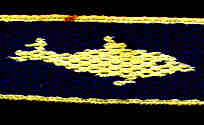
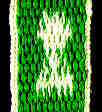
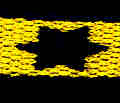
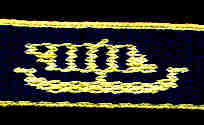
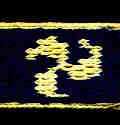

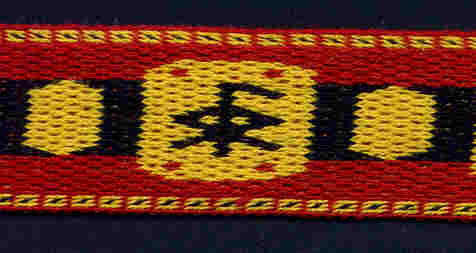
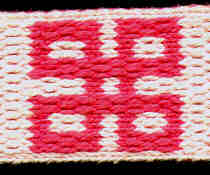
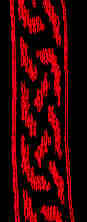
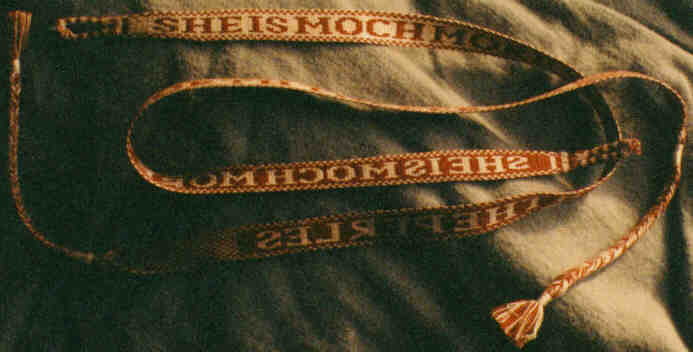
The first known pieces that utilize this technique are two of the tablet woven finds from the Hallstatt menses Celtic chieftain's grave at Hochdorf. These bands date to most the late sixth century BCE. Hochdorf Band B alternates areas of 3/one broken twill double-face weave and areas of alternately threaded double-face weave with the assist of tablet idling. The patterns in the non-twill double-confront area are horizontal to the weave, i.e., they run beyond the warp rather than along it or on a diagonal. Hochdorf Band C, a fragment, is threaded SSZZSSZZ and shows a elementary diamond-shaped meander pattern in double-weave combined with continuous forrard turning (Knudsen, 55-59).
An eighth-century Byzantine tablet-woven ring found at Moscevaja Balka at the northwestern stop of the Caucasus Mountains (about the Sea of Azov) is worked in Greek lettering (Ierusalimskaja, 251f). Although the write-upwards isn't clear almost the specific tablet-woven technique employed, the photo suggests alternately-threaded double-face weave. The Greek upper-case letter letters, with their prominent weftwise ascenders, would non look nearly so crisp in a twill weave.
A later piece, more widely known from its publication in Collingwood, is an unpatterned Egyptian one. Dated to nearly the 10th century, it displays the feature weave construction of alternately-threaded double weave but no woven patterning; instead, information technology bears an embroidered inscription (Collingwood, 229). Later on this weave also appears in two geometrically patterned Scottish seal tags from about the plough of the thirteenth century; yet, both these ribbons are threaded in the same direction (Henshall, 155-59).
The same technique is found in one of the medieval London bands, "Braid 143" (Crowfoot, notes), dating from the mid-fourteenth century. It is a fine, narrow silk band patterned with lozenges.
The finer and more numerous the warp threads, the greater the resolution which is possible in a design of this sort. Depending on the size of thread you use, this technique produces impressive belts, baldrics, trim, straps, ribbons, and fifty-fifty club badges.
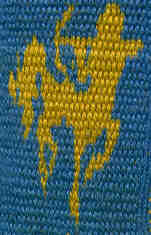
Lord Kormakr the Teeth made an order badge (using well-nigh 85 cards threaded with unmarried strands of embroidery floss) that was given out at the Coronation of Balfar I and Luna I in the East Kingdom in October, A.South. XXVI (1991).
Before Warping the Loom
2 kinds of drafts are required to weave in this technique: the warping draft and the pattern draft. The warping typhoon is covered in the next section, "Warping the Loom." But the pattern draft usually needs to exist worked out before the warping can exist arranged, and this is how it's done. Commencement, choose a design: one of the charges from your device, your favorite animal, a household keepsake, a geometric motif, or even your proper name in runes. Motifs with 45-degree lines piece of work best; those with horizontal and vertical lines work least well but can still exist approximated. Your design should middle on two tablets, although information technology need not be symmetrical.
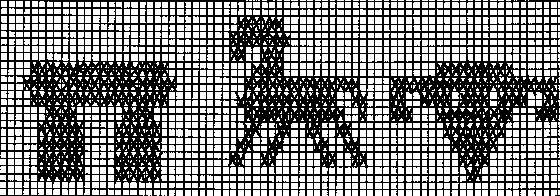
Now transfer your pattern to graph paper. Drafts for this technique are drawn on a grid consisting of rectangles: each rectangle represents two throws of weft for one tablet's worth of threads. Draft a pattern on plain graph paper, using a ratio of two vertical squares to each horizontal ane. Each vertical square represents one pick of the weft; each horizontal square represents one tablet's worth of threads. Run into below for 3 sample drafts; note how each X in each typhoon covers ii foursquare boxes of the graph paper.
When figuring out how many tablets to warp, outset count the number of pattern tablets y'all take used, and then add together a multiple of 2 tablets (two is usually sufficient for a chugalug- or trim-sized piece) at both sides of the blueprint. These extra tablets will help the pattern you weave stand out more than conspicuously past framing it in plain double-face weave of the background color. This gives you the total number of tablets you need to warp in the double-face warping typhoon. But yous should also effigy on another multiple of 2 tablets at each side to make neat warp-twined selvedges. Again, 2 tablets at each side is generally sufficient unless you take a total pattern of xxx or more than tablets; for such pieces, use four tablets or more per selvedge.
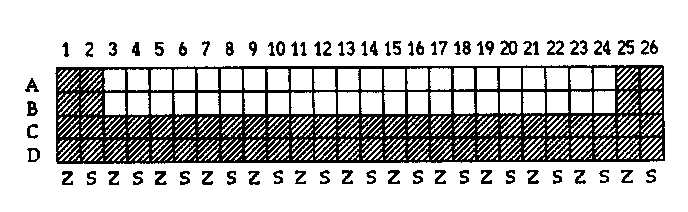
Example: You lot have drafted a pattern that'southward eighteen tablets wide (for case, the horse motif above). Add together to that 2 tablets at each side of the blueprint, for the apparently double-confront weave "frame"; that gives yous 22 tablets. Now add to that 2 tablets at each side for the selvedges; that gives you lot a total number of 26 tablets to warp. Tablets i-2 and 25-26 are warped all in one colour, and tablets 3-24 are warped with two colors as noted in the draft below.
Once y'all have figured out how many tablets you need, then you should number the tablets of your draft, beginning with the 2 center tablets and working outward toward both ends in order to minimize mistakes.
Warping the Loom
Starting with your manifestly warp-twined selvedges, thread all the odd-numbered tablets Z-wise and all the fifty-fifty-numbered tablets Due south-wise. For the most uniform effect, your selvedges and your weft thread should all be the same color every bit the groundwork of your piece. All the tablets that are not selvedge tablets should be threaded A and B with the design color, C and D with the groundwork color. Come across the sample draft beneath.
If you double-cheque your threading before you first to weave, it will probably salvage y'all some headaches. It shouldn't take you more than a minute to thumb through the pack and make sure that
- each tablet is threaded in the opposite direction from the two tablets on each side of it, and
- holes A and B of all the tablets except the selvedges are filled with the blueprint colour.
Weaving
Weave continuously forward for a brusque while, in order to spread out the threads evenly; y'all can use a thicker weft for this section if y'all like. When you're prepare to start the double-confront, make certain that all the tablets are in home position. Weave 2 turns forward; you will note that B and C are now uppermost. Next turn the selvedges frontward while you plow the other tablets backward for two turns; yous will discover that A and D accept returned to being uppermost. This sequence (two forrad, two backward) will be your basic turning sequence. As long as you repeat this sequence, you lot volition get a manifestly, unusually textured weave which is one color on ane side and another color on the other side.
You can begin a pattern whenever the tablets are in home position (or, later you get used to the technique, whenever B and C are up), i.e., after two turns of the tablets in the aforementioned direction. When you want to begin a blueprint, bank check to make sure the advisable holes are uppermost, then refer to your typhoon to see which tablets need to exist moved. Slide all the tablets of the pattern away from y'all into a second turning pack. Then weave two picks of the normal turning sequence, turning the near pack (background) and the selvedge pack forward; meanwhile, turn the far (pattern) pack backward. The general rule here is that the background pack will always plow in the standard turning sequence (explained in the previous paragraph), while the blueprint pack always turns in the contrary direction from the background pack.
You have now completed the first row of your pattern draft--two vertical boxes past one horizontal box on the graph paper. For the second row of your draft, slide all the tablets for the pattern into the far pack, sliding back into the near pack any tablets which render to being background tablets. Then slide the selvedge pack dorsum even with the far pack and weave two more picks, turning the selvedge pack and the far pack forward while you lot plow the near pack backward. You accept now completed the commencement two rows of your pattern, and your tablets should all be in home position again.
The bones series of activities that is repeated for every two picks of weft in this techniques is this:
- consult pattern draft;
- movement all tablets that need to exist moved;
- motility selvedge pack;
- weave the two picks; and
- motion the place-holder on your blueprint typhoon to point the adjacent row to weave.
Special Notes
While you are learning this technique, it is really very helpful (although not necessary) to always slide your selvedge pack back and forth from near to far to near pack; this process volition help yous make up one's mind which way to turn which pack from row to row of your blueprint. Once yous accept gotten the hang of it, of course, you can keep track in whichever way suits you best.
The pattern you weave volition be slightly longer than your draft. The harder you beat, the less out of synch the woven pattern volition exist with the draft. Drafting on a grid of iii-to-ane ratio, in order to compensate for this trouble, causes even more problems: it'due south more difficult to draw and it's less intuitive considering the turning sequence for this technique is based on units of two, not of three. Additionally, you volition air current upwards with a typhoon which is longer than the pattern you weave from information technology.
This technique is suited especially to motifs with diagonal outlines. Weftwise outlines come out rather jagged, and warpwise outlines are slightly wavy. It is possible, however, to get very crisp diagonal outlines. The appearance of the woven pattern volition vary slightly from the typhoon, based on the relative plying of the cords; experience volition show y'all how to capitalize on these variations.
You will brand mistakes and take to disengage threads from time to time. Simply be patient; it'due south a good learning process.
References
Collingwood, Peter. The Techniques of Tablet Weaving. New York: Watson-Guptill, 1982.Recently reissued in paperback, Collingwood'due south book has a wealth of general comparative data and construction techniques, not all of which are menses to the SCA. There is a long affiliate department on the Due south-Z technique in this book.Crowfoot, Elisabeth. Unpublished museum notes on Museum of London Band 143.
These notes were kindly supplied to me by Frances Pritchard.Crowfoot, Elisabeth; Pritchard, Frances; and Staniland, Kay. Textiles and Clothing c.1150 - c.1450. Medieval Finds from Excavations in London, four. London: Her Majesty'south Stationery Role, 1992.
A section of the "Narrow Wares" chapter illustrates and catalogues some tablet weaves, including one in patterned S-Z double-face and one in an unpatterned textural version of the same weave.Henshall, Audrey. "Five Tablet-Woven Seal-Tags." Archaeological Journal, Vol. 121 (1964), pp. 154-62.
Analysis of 5 very tiny tablet-woven pieces in silk; i is threaded-in, two are double-face, one is iii/1 broken twill double-confront, and i is brocade.Ierusalimskaja, Anna A. Die Gräber der Moscevaja Balka: Frühmittelalterliche Funde an der Nordkaukasischen Seidenstrasse, trans. I.M. Smoljanski and Ursula Rosenschon. München: Editio Maris, 1996.
Contains a Greek silk ring with a military inscription in double weave.Knudsen, Lise Ræder. "Analysis and reconstruction of two tabletwoven bands from the celtic burial hochdorf," pp. 53-60 in Gisela Jaacks and Klaus Tidow, eds., Textilsymposium Neumünster: Archäologische Textilfunde--Archaeological Textiles four.-seven.5.1993. NESAT [North European Symposium on Archaeological Textiles] 5. Neumünster: Textilmuseum Neumünster, 1994.
This data on the earliest known double-faced tablet weaves is a bit hard to decipher but very useful.Pritchard, Frances. Personal communication (letter to author dated 15th September 1993).
This page was created on 26 Feb 1997 and last updated on nine December 1999.
Search this site | Back to Þóra'south Textile Resource
No soliciting! | capriest@cs.vassar.educorbettfehourempard88.blogspot.com
Source: https://www.cs.vassar.edu/~capriest/dfdt.html
0 Response to "How to Read a Tablet Weaving Pattern"
Postar um comentário